I didn't marry Ethan because of his birth chart. I married him because he made me laugh so hard I snorted iced tea through my nose on our third date. I married him because he remembered I don't like cilantro, and because he fixed my garbage disposal without being asked, and because he looked at me one night on our porch and said, "I don't think I'm supposed to figure you out. I think I'm just supposed to keep showing up."
But I also married him because—and I didn't fully understand this until we'd been married about eighteen months—his chart made me reconsider everything I thought I knew about compatibility.
Let's start with what the compatibility blogs get wrong
Before I met Ethan, I'd read all the astrological compatibility content I could find. And almost all of it was... nonsense, frankly. It treated relationship astrology like a compatibility quiz in a magazine: Fire signs pair best with Air signs. Water and Earth are a natural match. Avoid putting two fixed signs in the same room.
It reduced people to their sun signs, as if the entirety of a person's capacity to love, fight, and grow could be summed up by their month of birth. It told women to "how to make a [sign] man commit" and served up gender stereotypes like horoscopes were fortune cookies.
When I pulled Ethan's birth chart—he'd never had one done before, and he made fun of me for the entire hour it took to calculate it—I was expecting something straightforward. I'm a Taurus sun, Gemini rising, Pisces Venus, Aries Mercury, Cancer moon. He's a Virgo sun, Capricorn rising, Virgo Venus, Libra Mercury, Scorpio moon.
The compatibility blogs would have told us we were a "challenging match." Earth and Earth, but with wildly different expression styles. The astrology apps would have flagged our Venus placement (Pisces vs. Virgo) as a fundamental incompatibility. Some of them would have warned us off each other entirely.
And if I'd believed that, I would have missed the most profound learning experience of my life.
What I actually saw when I looked at our synastry
Here's what our charts together taught me—not in the simplified "you're compatible" sense, but in the real, daily, exhausting, beautiful sense.
1. Your opposite placements aren't obstacles. They're assignments.
Ethan's Venus is in Virgo. He shows love through acts of service. He remembers to change my car's oil. He fixes the squeaky cabinet hinge. He brings me coffee exactly the way I like it—oat milk, one sugar, not too hot. When he's stressed, he cleans the kitchen. That's how he processes. That's how he says "I love you."
My Venus is in Pisces. I show love through emotional attunement. I write him notes. I ask him about his day and hold space for his feelings. I notice when he's quiet and ask what's underneath. I try to see him, fully and tenderly.
For the first two years of our marriage, we were both exhausting ourselves trying to love the other in our own language—and then feeling unseen when the other didn't reciprocate the same way. I would feel deeply hurt that he didn't ask me about my emotional state. He would feel unappreciated that I didn't notice the oil change.
The synastry chart didn't solve this—it just named it. It showed me that we were speaking different dialects, and that the translation work was our responsibility, not the other person's failure.
The lesson: Incompatible Venus signs aren't a red flag. They're a syllabus. You have to study each other's languages, or you'll talk past each other forever.
2. His Moon and my Moon were a masterclass in emotional needs
Ethan's moon is in Scorpio. That means his emotional interior is deep. He feels things profoundly, but he doesn't show them on the surface. When he's hurt, he retreats into silence. He processes internally. He needs privacy to unravel. If I push him to "talk about it" before he's ready, he shuts down further.
My moon is in Cancer. That means I need emotional mirroring. When I'm upset, I need someone to hold me, look me in the eye, and say "I see you, I hear you, I'm with you." Silence feels like abandonment to me.
You can see where this goes, right?
When we fight, I want to talk immediately. He needs to walk away and think. I interpret his walking away as rejection. He interprets my pursuit as pressure. Neither of us is wrong—we're just different.
Understanding our moon signs didn't stop the dynamic. But it gave us a script. I can say, "I need ten minutes of connection before I can give you space." He can say, "I need an hour to process, and then I'll come back to you." We've learned to ask for what we need instead of accusing the other of withholding.
The lesson: Your partner's moon sign isn't an excuse for them to avoid connection, and yours isn't an excuse to invade their space. It's a roadmap for negotiating the gap between your two emotional worlds.
3. The Mercury difference was the biggest communication breakthrough

Here's the part that surprised me. I thought our moon signs would be the hardest part. But the real daily friction was our Mercuries.
Ethan's Mercury is in Libra. He speaks carefully. He weighs every word. He edits himself in real time. He needs to be fair, balanced, and precise. Sometimes I want to scream, "Just say what you mean!" but that's not how his brain works.
My Mercury is in Aries. I speak fast. I think out loud. I say things before I've fully processed them, and then sometimes I say, "Actually, scratch that." I'm not being sloppy—I'm just processing in real time. Aries Mercury is like a fire hose: powerful, direct, but occasionally messy.
In our first year of marriage, we had arguments that were entirely Mercury miscommunications. He would say something carefully, I would interrupt with a rapid-fire response, he would feel dismissed, I would feel misunderstood. We'd walk away from conversations thinking we'd resolved things, only to discover we'd heard completely different versions of the same discussion.
Looking at our Mercuries allowed us to create a system: I give him a head's up before I'm about to think out loud ("I'm going to brainstorm this, not decide it"). He gives me a head's up before he needs to pause to find the right words ("Give me a second, I'm searching for the right way to say this"). We don't fix the communication gap—we just communicate about the communication.
The lesson: Communication issues aren't usually about one person being "bad" at it. They're about different processing speeds and styles. Once you understand each other's default settings, you can build workarounds.
What the astrologers don't tell you
All the compatibility blogs I'd read before marriage would have told us to pay attention to our sun signs, our Venus signs, our Mars signs. And those are relevant. But no one told me that the real work is in the gaps.
Here's what I've come to believe after eight years of relationship counseling and four years of marriage:
Compatibility isn't about matching. It's about complementing.
Ethan and I are not "soulmates" in the sense that we're effortless. We're soulmates in the sense that we're willing to do the effort for each other. His Virgo attention to detail balances my Taurus impatience. His Libra Mercury slows down my Aries fire hose. My Pisces Venus softens his Virgo reserve. My Cancer moon teaches him to name his feelings; his Scorpio moon teaches me that silence can be intimacy too.
If our charts were identical, we'd never grow. We'd be perfectly aligned—and perfectly stagnant.
The chart doesn't tell you whether you should be together. It tells you what you're signing up for. It's not a verdict. It's an invitation to understand.
Cosmo walks: the real chart
You might be wondering why this column is called "Cosmo Walks" when I'm talking about my husband.
Here's the thing: Ethan and I do our best marriage work when we're walking Cosmo. Not in therapy. Not sitting across from each other at a table. Walking. Side by side, moving forward, not facing each other directly.
There's something about walking that lowers the stakes. You don't have to make eye contact. You're both looking ahead. Hard conversations feel more possible when you're in motion.
Cosmo—our anxious terrier mix—doesn't know anything about Venus signs. He doesn't know that his people are two wildly different Mercury placements. He just knows that when we walk, we talk. And when we talk, we stay.
Ethan and I have had our best conversations on the Barton Springs trail—about our childhoods, about our fears, about the things we're too scared to say directly. Not because the stars aligned. Because we showed up.
The chart gives you a map. The walk gives you the steps.
What I'd tell couples who are chart-diving
If you're reading this and you've just pulled your partner's birth chart—or you're thinking about doing it—here's my advice, in three parts:
1. Don't use the chart to confirm your fears. If you're worried he's "avoidant," don't scan his Moon sign for proof. Read the chart as a curious observer, not a prosecutor.
2. Don't treat it like a test. Your partner's chart doesn't prove they're "the one" or "not the one." It just shows you their default emotional, communication, and relational settings. You still get to decide whether you want to work with those settings.
3. Use it as a bridge, not a weapon. If your chart shows that you're both fixed signs, don't use that as an excuse to stop trying. Use it as a conversation starter: "How do we work with our stubbornness so it doesn't hurt us?" The chart is a question, not a verdict.
The marriage that happened despite the chart
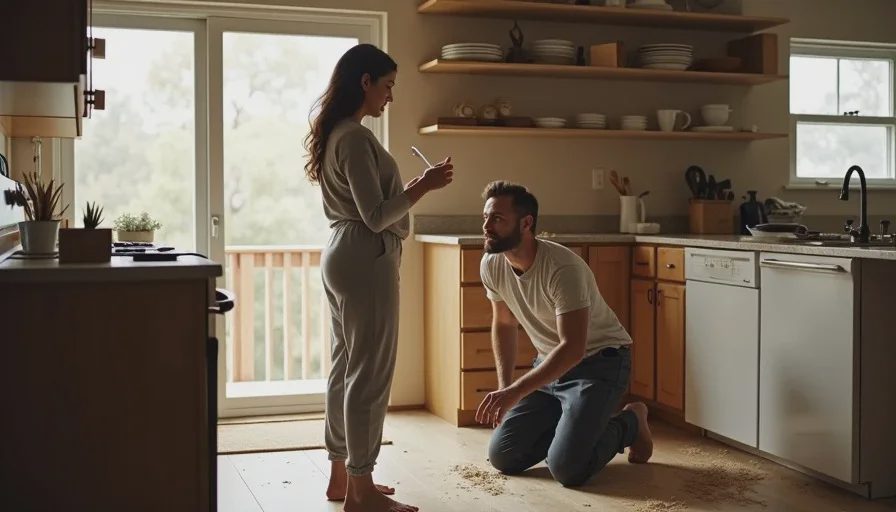
Ethan proposed on a Tuesday, in our kitchen, after I'd been ranting for twenty minutes about a client. I was in sweatpants. He was covered in sawdust from fixing a shelf. He didn't kneel. He just looked up from the floor and said, "I think we should do this forever, don't you?"
I said yes before he finished the sentence.
His sun sign? Virgo. My sun sign? Taurus. Astrologically, they're "square"—a challenging aspect. We're not "effortless."
But marriage isn't effortless. Marriage is a practice. You practice showing up. You practice repair. You practice translating each other's languages. And eventually, the translation gets smoother, even if it's never perfectly fluent.
Our charts didn't predict our marriage—they just gave us the vocabulary to do the work.
And for that, I'm grateful.
No comments yet.