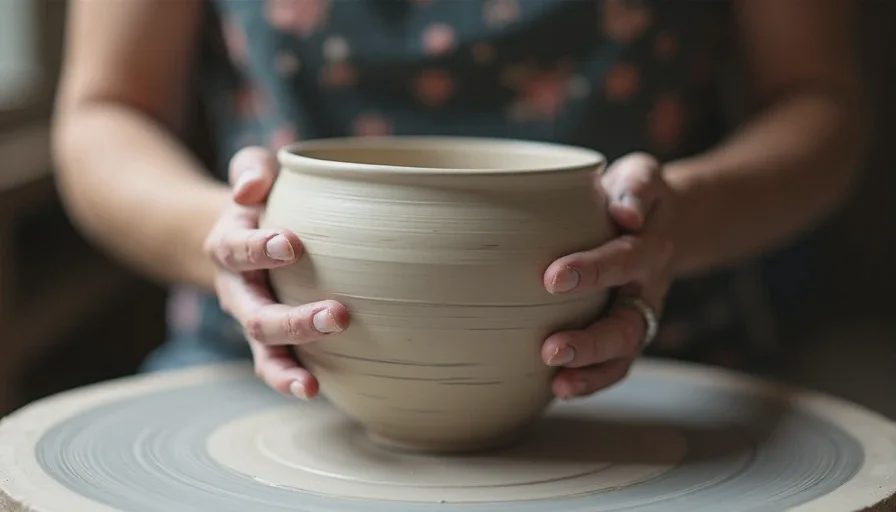
The first bowl I ever threw collapsed in my hands.
I'd spent twenty minutes centering the clay—pushing, pulling, coaxing it into a perfect, spinning cone. My hands were wet, my shoulders ached, and I was so focused I'd forgotten to breathe. I was certain I'd done everything right. I'd watched ten YouTube tutorials. I'd practiced on air for two weeks. I was ready.
I pressed my thumb into the center, opened the clay, and pulled up the walls. It was working. It was actually working. The bowl was rising, smooth and elegant, exactly the shape I'd envisioned.
And then—for no reason I could name—it wobbled. One side leaned outward. The rim rippled. I tried to correct it, to push it back into shape, but the more I pushed, the more it deformed. Within seconds, the whole thing slumped into a sad, lopsided mess.
I stared at it. I'd done everything right. What went wrong?
My pottery teacher—a woman in her seventies who'd been throwing for fifty years—walked over, looked at the collapsed clay, and said: "You were fighting it. The clay isn't your enemy. It's your partner. You have to listen to it, not just tell it what to do."
I didn't understand then. I do now.
Because that's exactly what I'd been doing with my own life—and with my clients' charts.
The illusion of control
When I first started learning astrology, I treated it like a system to be mastered. I memorized the planets, the signs, the houses, the aspects. I learned the rules. I thought if I just understood the framework well enough, I could predict—predict behavior, predict outcomes, predict relationships.
I was treating the chart like clay I could shape. Like if I just pushed hard enough, I could make it conform to my expectations.
But astrology doesn't work that way. Neither does pottery. Neither does life.
The clay has its own properties. It has a memory. It responds to pressure, to moisture, to speed. If you push too hard, it resists. If you rush, it collapses. If you don't listen, it lets you know—by falling apart in your hands.
The chart is the same. It's not a set of instructions to be followed. It's a material to be worked with. You can't force a person to be something their chart doesn't support. You can't bend the clay into a shape it wasn't meant to take. You can only collaborate with what's already there.
The centering practice
Before you can make anything on a pottery wheel, you have to center the clay. You push it down, pull it up, and push it down again, over and over, until it spins without wobbling. It's the most important step—and the most frustrating. If the clay isn't centered, nothing you make will hold.
Centering the clay taught me something I'd been missing in my therapy practice: you can't build anything stable on a foundation that's not stable.
I spend a lot of time with clients who are trying to build new patterns on old foundations. They want to change their relationship habits, their communication styles, their self-worth—but they haven't done the work of centering. They haven't addressed the wobble at the core.
Centering in astrology means understanding your fundamental patterns—not just your sun sign, but the full constellation of your chart. It means acknowledging where you're strong and where you're lopsided, where you hold pressure and where you collapse.
When I look at a client's chart, I'm not looking for a diagnosis. I'm looking for their center. What's stable? What's wobbly? What needs to be addressed before we can build anything new?
The pull: creating from the center
Once the clay is centered, you open it. You press your thumb into the center, creating a hole. Then you pull the walls up, slowly, gently, using the clay's own momentum.
This is the part where people usually mess up. They pull too fast. They try to make the walls thinner than the clay wants to go. They get impatient and force it—and the whole thing collapses.
The key to pulling walls is patience and pressure. You need steady, consistent pressure—but not too much. You need to listen to the clay. If you feel resistance, you don't push harder. You slow down. You adjust. You let the clay tell you what it needs.
This is what I've learned about change—in myself and in my clients:
Change isn't something you force. It's something you allow.
You can't make someone heal faster than they're ready. You can't force a pattern to release before it's ready to go. You can only stay present, apply steady pressure, and wait for the clay to respond.
This is especially true with water signs, who need time to feel before they can act. With earth signs, who need to build slowly and steadily. With fire signs, who need to release energy in bursts. With air signs, who need to understand before they can commit.
The chart tells you the clay's consistency. Your job is to work with it—not against it.
The wobble: what you learn when things go wrong
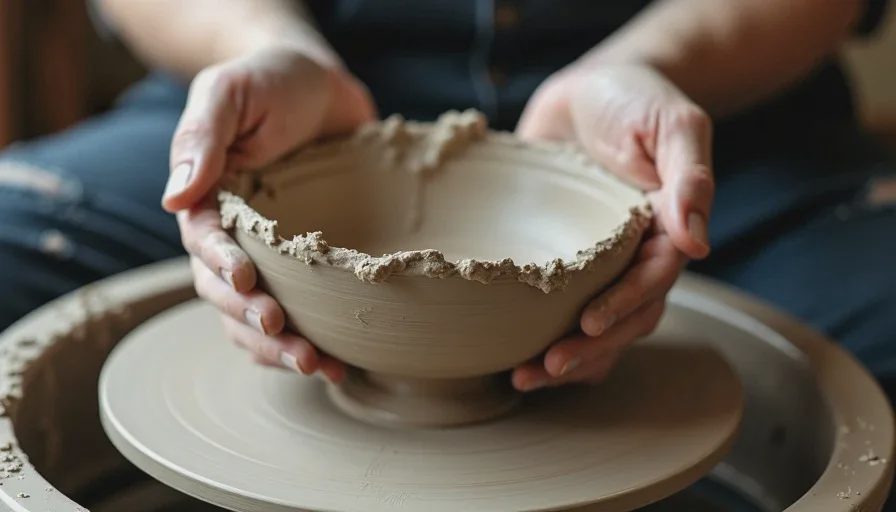
In pottery, things go wrong constantly. The clay wobbles. The walls collapse. The rim cracks. And every time it happens, I have a choice: get frustrated and give up—or pay attention to what the clay is telling me.
The first time I made a functional bowl—one that held water without leaking—it wasn't because I did everything perfectly. It was because I'd made enough mistakes to understand the clay's language. I knew when it was too wet, too dry, too thin, too heavy. I knew how much pressure it could handle.
Mistakes aren't failures. They're data.
The same is true with birth charts. When a client comes to me with a pattern they can't break—a relationship they keep repeating, a career they can't commit to, a fear they can't name—I don't see a problem to be solved. I see data. I see the clay telling me where the wobble is.
If you keep fighting with the same partner, it's not because you're bad at relationships. It's because your charts are pointing to a dynamic you haven't learned to work with. If you keep leaving jobs before they get hard, it's not because you're unreliable. It's because your chart is showing you a pattern of avoidance that needs attention.
The wobble is information. Don't fight it. Read it.
The firing: what survives the heat
After you've thrown a piece, it has to be fired. Twice. The first firing is the bisque—it hardens the clay, turns it into something stable. The second firing is the glaze—it adds color and durability, but only if the piece survives the process.
Pottery breaks in the kiln. It cracks. It explodes. Sometimes the pieces you were most confident about don't survive, and the pieces you were sure would fail come out beautiful.
The firing taught me something about patterns: not everything you build will survive the heat of life.
Some relationships break under pressure. Some careers crack. Some dreams explode. That's not a failure. That's the process. The question isn't whether you'll break. The question is what you'll do with the pieces.
I've had clients who lost everything—relationships, jobs, health—and came out stronger than before. Not because the loss was good. Because the loss revealed what was already broken. The firing didn't destroy them. It just burned away what wasn't real.
Your chart doesn't tell you what will survive. It tells you what you're working with. The rest is up to you.
What clay taught me about patterns
Here's what I've learned, after years of throwing pots and reading charts:
Patterns aren't prison. They're material.
You don't have to "break" your patterns. You have to understand them. You have to know what they're made of, where they came from, what they're trying to protect. And then you have to decide—slowly, gently—whether you want to keep working with them or shape something new.
Rushing doesn't work.
Whether you're on the pottery wheel or in a relationship, speed isn't the answer. Presence is. You can't force change. You can only show up, apply steady pressure, and wait.
Your hands know more than your brain.
When I center clay, my brain isn't in charge. My hands are. They feel the wobble before I can name it. They adjust before I can tell them to. This is what the body knows—what the chart can't capture, but the Moon can.
The most beautiful pieces come from the most challenging clay.
My favorite pieces are the ones that almost collapsed. The ones I had to rescue multiple times. The ones that taught me something. They're not perfect. They're interesting. They have character.
The same is true of people. The ones with the most challenging charts—the hard aspects, the intense placements, the complicated patterns—are often the most interesting. They've been through the firing and survived. They've learned to work with their material.
The clay and the chart
I don't throw pottery because I want to make perfect bowls. I throw pottery because it teaches me something I can't learn any other way: how to collaborate with what is.
The clay is what it is. I can't change its properties. I can only work with them. The chart is the same. I can't change someone's placements. I can only help them work with them.
The bowl that comes off the wheel is never the bowl I imagined when I started. But it's always something I couldn't have made if I'd been in control.
That's the practice. Not forcing. Not fixing. Just showing up, staying present, and trusting the process.
No comments yet.