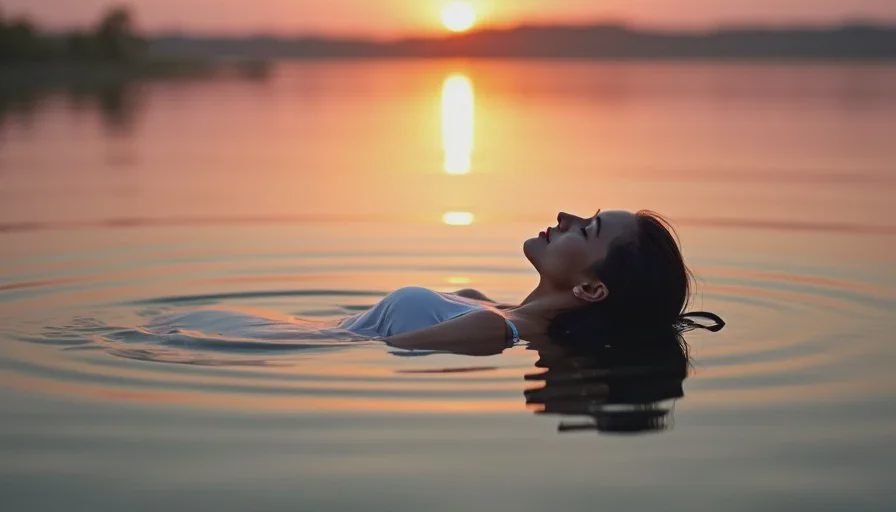
The first time I jumped into Barton Springs, I screamed.
Not a dramatic, movie-style scream. A small, involuntary, what-is-happening-to-my-body yelp that came out before I could stop it. The water was 68 degrees Fahrenheit—cold enough to steal your breath, warm enough that you don't go into shock. But that first plunge? It felt like my entire nervous system had been rebooted without my permission.
I scrambled out, shivering, vowing never to do it again.
That was six years ago. I haven't missed a morning since.
Well—that's not entirely true. I've missed maybe a dozen mornings, total. When I had the flu. When I was out of town. When the storms were bad enough that even I wasn't crazy enough to drive to the pool. But on every other morning, rain or shine, summer or winter, I'm in that water at 6 AM.
People ask me why. They ask if I'm training for something (I'm not). They ask if it's a discipline thing (it's not). They ask if I'm secretly a masochist (jury's out on that one).
The truth is simpler: I start my day in cold water because I need to remember that I can survive discomfort.
The first shock
There's something about 68-degree water that doesn't let you negotiate. You can't ease into it—not really. You can wade in slowly, but that just extends the suffering. The only way through it is to commit. To dive. To let the cold hit you all at once and then keep going.
For the first thirty seconds, my body screams at me. Get out. This is wrong. This is dangerous. What are you doing to us? My breath catches. My muscles tighten. Every instinct tells me to flee.
And then—somewhere around the minute mark—something shifts.
The cold stops being an enemy and becomes a presence. It's still intense. It still demands my full attention. But it's no longer a threat. It's just what's happening right now. And I'm still here. I'm still breathing. I'm still okay.
I've been a therapist for long enough to know that this is not just about water. This is a practice in staying present through discomfort. And that is a skill that transfers to every other part of my life.
The 6 AM emptiness
I choose 6 AM for a very specific reason: there's no one else there.
Not literally—there are usually a few other regulars, the ones you nod at but never learn the names of. But the pool is empty in a deeper sense. The city is still asleep. The noise hasn't started. The demands of the day haven't arrived. For that hour, I am the only person I need to show up for.
That's rare in a therapist's life. Most of my day is spent holding space for other people's emotions, other people's chaos, other people's urgent needs. At 6 AM, there's no one to hold but myself.
I float on my back and look at the sky. Sometimes it's pink and gold. Sometimes it's gray and quiet. Sometimes it's so dark I can still see the stars, and I think about how long it's been since I really looked at them—not as a chart, not as a symbol, just as light that traveled millions of miles to reach me.
That's when I remember the other part of my work. The part that's not about diagnosis or treatment plans or attachment theory. The part that's just: we are small, and the universe is vast, and somehow we're still here, still breathing, still trying.
The daily surrender
Every day, I have to choose to get in. Even on the mornings when I don't want to. Even when the air is cold and the water is colder. Even when I'm tired, or sore, or just not in the mood.
That's the practice. Not the swimming—I'm a terrible swimmer, actually. I mostly just tread water. The practice is the choosing. It's the act of deciding that this discomfort is worth it, that this small ritual matters, that I am worth taking care of in this particular, slightly strange way.
There's a Buddhist idea I think about sometimes: surrender doesn't mean giving up. It means giving in to what is.
The cold water doesn't care if I'm having a good day or a bad day. It doesn't adjust itself to my mood. It's 68 degrees every single morning. My surrender is accepting that. Not fighting it. Not complaining about it. Just being present with it.
And in that surrender, I find something I don't find anywhere else: a complete absence of control, and a complete peace with that.
What the water teaches me about therapy
I've been a licensed counselor for eight years. I've sat across from hundreds of people in crisis. I've held space for grief, rage, confusion, hopelessness. And there's a pattern I've noticed:
Most people spend their lives trying to avoid 68-degree water.
They avoid the hard conversations. They avoid the painful feelings. They avoid looking at the parts of themselves they don't want to see. They build elaborate structures to protect themselves from discomfort—and then they wonder why they feel so trapped.
My work with them is like the water: I can't make the cold go away. I can't promise them it won't hurt. But I can say, "You can survive this. I know you can. I've done it myself, and you can too."
Barton Springs taught me that. Not through theory. Through experience.
Every morning, I prove to myself that discomfort is survivable. That the cold passes. That you can breathe through it. And then I carry that knowledge into my sessions.
When a client says, "I can't handle this," I don't tell them they're wrong. I just say, "Can you handle it for one minute? That's all. Just one minute. Let's see what happens."
That's what the water gave me: the permission to take hard things one minute at a time.
The community of the early morning
I mentioned the other regulars. There's a woman in her seventies who does laps like she's been swimming her whole life. There's a man who brings a waterproof speaker and plays classical music quietly. There's a young guy who dives in, does one lap, and leaves—like he's just checking a box.
We don't talk much. It's not that kind of place. But there's an understanding between us: we are all here doing the same thing. We are showing up, alone and together, to something that doesn't ask for anything but our presence.
I've learned more from watching those people than I have from most books. The older woman taught me that you can keep showing up even when your body is tired. The music guy taught me that you can bring beauty into even the most intense moments. The young guy taught me that sometimes just showing up is enough—you don't have to stay long.
Cosmo sometimes comes with me, sitting in the car while I swim. He stares at me through the window like I've lost my mind. I think he's right, actually. But I also think losing your mind, a little, is part of finding your heart.
The return
After twenty minutes—never more, never less—I get out.
The air feels warm compared to the water. That's the trick: cold water makes everything else feel like a gift. The towel, the coffee waiting in the car, the heat of the sun on my skin. These are not luxuries. They are ordinary. But the cold water reminds me that ordinary things are actually extraordinary.
I drive home with wet hair, usually in my swimsuit, occasionally getting stares at red lights. I make coffee. Ethan is usually still asleep—he's not a morning person, and he thinks I'm absolutely insane. Cosmo has claimed the spot I left warm in bed.
And then I sit down to write.
Most of my best posts start as thoughts I had in the water. Things I couldn't access when my brain was busy. Things that only surfaced when my body was fully engaged in the present moment.
That's the other thing cold water does: it shuts up the thinking brain long enough for the feeling brain to speak.
What I've learned after six years
After six years of 6 AM cold water, here's what I know for sure:
Discomfort is survivable. You can breathe through it. You can stay present with it. And eventually, it changes shape.
Routine is sacred. It's not about discipline. It's about showing up for yourself, consistently, even when you don't feel like it. That's how trust gets built—with yourself.
Sensory experience heals what words can't reach. You can talk about anxiety for years. Or you can jump into cold water and feel your nervous system reset in real time. Both are valid. The water just works faster.
The first step is always the hardest. Every morning, I hesitate for one second. Every morning, I take the plunge anyway. That single second of hesitation never wins. It's just a reminder: I can do hard things.
We need physical anchors. Not just mental frameworks. Not just intellectual understanding. We need things we can feel—water, clay, sun, earth. Things that remind us we have bodies, not just brains.
The invitation
I'm not telling you to start swimming at 6 AM. I'm not telling you to jump into cold water—though I'd recommend it, if you're brave.
I'm telling you this: find your 68-degree water.
Find the thing that wakes you up. The thing that demands your full presence. The thing you can't do half-heartedly. The thing that reminds you that you are alive, that your body is real, that discomfort is not the end of the world.
It could be running. It could be yoga. It could be cooking. It could be sitting in silence. It could be walking your dog at dawn. It doesn't matter what it is—it only matters that it's yours.
That's what Barton Springs is to me. A daily reminder that I can handle what comes. A daily vote for my own survival.
It's 6 AM. The water is waiting.
No comments yet.